Voice and audio
Microphone arrays, wake behavior, speakers, amplifiers and acoustic paths are designed for the toy form.
AI toy engineering
Describe how the toy should listen, respond, move, light up or connect. We translate that experience into voice architecture, electronics, firmware, power, enclosure and a production plan.


Voice + sensors + firmware + production
A simpler start
A sketch, character, specification or reference product is enough for an initial feasibility review.
Clear portfolio role
Develop AI, voice, sensor and connected toy systems that require electronics, firmware, interaction and production engineering.
Conventional plush, standalone printed products and generic manufacturing content stay on their own specialist properties.
What this team solves
Every capability below connects to the same brief, approvals and target launch.
Microphone arrays, wake behavior, speakers, amplifiers and acoustic paths are designed for the toy form.
Controls, power, connectivity, firmware and update behavior move from block diagram to functional prototype.
On-device, cloud or hybrid processing is chosen against latency, privacy, cost and connectivity.
Plush, robot or hard enclosure decisions protect acoustics, sensors, access and the intended play pattern.
Age grade, data assumptions, parental controls, battery access and target-market requirements enter scope early.
Tooling, functional fixtures, provisioning, pilot builds, packaging and inspection follow the approved architecture.
Buyer advantage
Latency, privacy, power, connectivity, acoustic performance and update behavior all compete for space and cost. The first engineering review forces those tradeoffs into the open.
Review My AI Toy ConceptApproval-led process
The next stage starts only when the current product decision is documented well enough to protect cost, quality and schedule.
Define what the child does, what the toy senses and how it responds.
Map processing, connectivity, audio, sensors, power and cost.
Validate the interaction, latency, acoustics and controls before tooling.
Integrate firmware, PCB, enclosure and production test requirements.
Provisioning, functional fixtures, inspection and packaging control the launch.
Interactive buyer tool
Choose the experience and constraints, then add your details. Send once and we reply with the first architecture and the questions to resolve before enclosure tooling.
Set the experience, the constraints and your details in one place. A single press returns the architecture and starts the engineering review.
Working recommendation
A single press returns this architecture and starts the engineering review. It is a planning aid, not a final engineering, cost or compliance decision.
Representative project patterns
These anonymized patterns demonstrate scope and process. Customer names and measured results require publication permission before indexing.

LED expression, voice response and touch input coordinated around a soft product form.
Review the decision path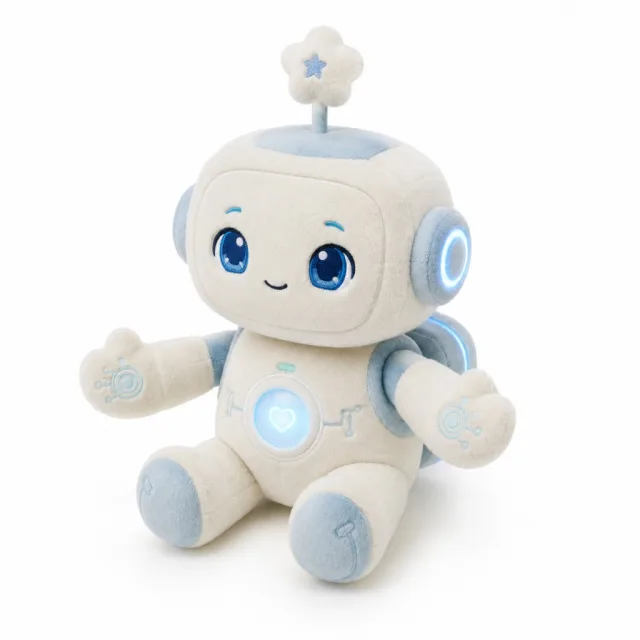
Character silhouette preserved while microphone, speaker and controls enter the body.
Review the decision path
Content, voice, safe controls and update behavior mapped before the engineering sample.
Review the decision pathIndexability gate
Every indexed feature page should connect to an engineer-reviewed diagram, prototype, test or demonstration, not a generic AI promise.
Prepare a better brief

Compare on-device, cloud and hybrid processing decisions.
Use this resource
Prepare microphone, speaker, language and content requirements.
Use this resource
See the approvals from experience brief through pilot build.
Use this resourceYes. The review maps your service, API and data assumptions to the toy hardware, connectivity, latency and provisioning needs.
No. Some experiences fit on-device processing, Bluetooth or preloaded content. Connectivity should follow the play pattern, not marketing language.
After the functional prototype validates acoustics, sensors, controls, power and the major architecture risks.
Often, yes. Define what setup, updates, parental control and content management must work without an app before architecture approval.
A standard-platform sample may take roughly 7 to 14 days after requirements and files are approved. Custom tooling, electronics, firmware or complex mechanisms receive a project-specific schedule after feasibility.
Your brand, characters, artwork and content remain yours. Ownership of paid custom deliverables is defined in the signed agreement, while Chloe Toys retains its pre-existing tools, reusable technology and manufacturing know-how.
Who we build for
From connected toy startups to established names, these teams trust us with the products they put their name on.





















Common question
Chloe AI Toy Lab does, as the Chloe Toys property for AI, voice, sensor and connected toy systems. You describe how the toy should listen, respond, move, light up or connect, and that experience is translated into voice architecture, electronics, firmware, power, enclosure and a production plan. A sketch, character, specification or reference product is enough for a first feasibility review. Conventional plush and standalone printed products are handled by the other specialist properties.